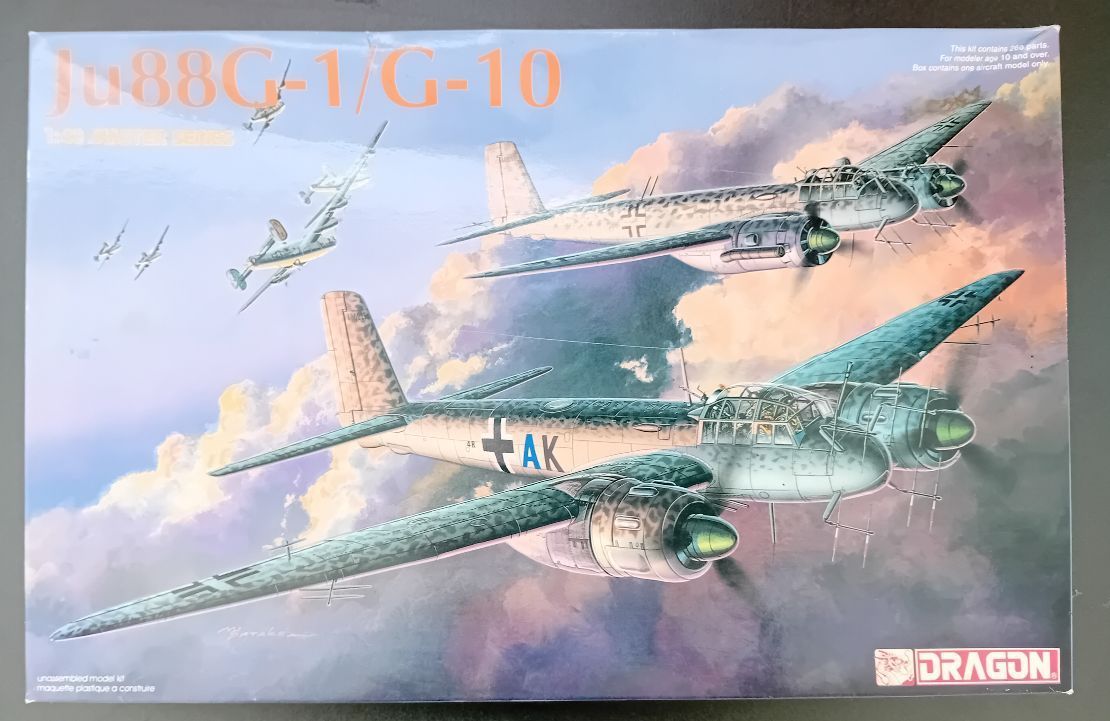
DRAGON DR5505+5521 1/48 Ju88G-1/G-10 + Horten Ho229A-1 Flying Wing , Master Series - aus Sammlungsaufkauf ( angefangene Modelle ) !!
The Junkers Ju-88 is a German, twin-engine, multi-role aircraft in the spine-wing configuration, with a classic tail and all-metal structure. The flight of the prototype took place on December 21, 1936, and the entry into service took place in 1939. The first production series was powered by Jumo 211A engines. Thanks to good flight characteristics, considerable performance and a solid construction on the basis of the Ju-88, several different versions of the aircraft have been created, performing various functions. The first mass-produced version is the Ju-88A, with many revisions. It served as a medium bomber. Its three revisions have been adapted to desert operations (A9, A10, and A11). Ju-88B planes, which were used as reconnaissance aircraft, were produced on a small scale. On the other hand, the Ju-88C was produced on a large scale, with BMW 801 engines, which was a great night fighter. The Ju-88-C6c version featured the SN-2 radar and the Schrage Musik cannons. The D version is another reconnaissance version, but with new engines. Another development model is the famous Ju-88G, which is a night fighter with more and more modern aircraft radars (SN2, SN3, FuG-218, and finally the FuG-240 centimeter radar in the Ju-88G-7C version) and more powerful versions of engines. In addition, the following versions were created: Ju-88H, Ju-88p, Ju-88S and Ju-88T. The plane was used during the September Campaign, the War in Western Europe and the Battle of Britain in 1940, on a large scale on the Eastern Front and in battles with the Allied bombing raids over the German skies. About 15,000 copies of this successful aircraft were built, all versions. Technical data (Ju-88G): length: 15.5 m, wingspan: 20.08 m, height: 5.07 m, maximum speed: 550 km / h, maximum range: 2500 km, maximum ceiling 9900 m, armament: permanent-4 MG151 cannons / 20 20mm machine guns, 1-2 MG131 13mm machine guns and 1-2 MG151 / 20 20mm cannons in the Schrage Musik system.
The Horten Ho-229 (the designations used are also Horten Ho IX or Gotha Go-229) is a German, twin-engine, jet fighter-bomber with a flying wing arrangement from the end of World War II. In cooperation with the Luftwaffe Sonderkommando 9 experimental center, in 1942 a project of the Ho-IX fighter plane with a flying wing system powered by two BMW 003A-1 jet engines was created. The construction of the V1 and V2 prototypes started soon and were completed in 1942. Problems with the BMW engine meant that the first Ho-IX V1 prototype was flown as a glider in the summer of that year, without engines and with a fixed front landing gear. However, the second prototype, the Ho-IX V2, was redesigned and equipped with Jumo 004 B-1 engines (2x8.5 kN). The flight tests with these engines began in January 1945. The plane reached the speed of about 800 km / h in the first flight, but after 2 hours of testing, the fire of one of the engines caused the prototype to completely crash during the landing attempt. Before that, however, the task of preparing the production was entrusted to the Gothaer Waggonfabrik plant, where the construction of prototypes under the designation Go-229 V3 to V7 began, as well as preparation for production of the Go-229 A-0 trial series. The first prototype made at Goth's plant (Go-229 V3), equipped with Jumo 004C (2x10kN) engines, was ready for testing, and work on the remaining prototypes (some of them in the two-seat night fighter versions) was seriously advanced when the plants were seized by American troops. Technical data: length: 7.47m, wingspan: 16.76m, height: 2.81m, maximum speed: 977km / h, rate of climb: 22m / s, maximum ceiling 16000m, armament: fixed-4 cannons MK108 cal. 30mm Suspended - up to 1000 kg of bombs.